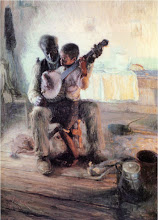
There was a world where the blue-haired ladies ruled. Hands were whacked for playing wrong notes. Mothers were told, 'The child has no talent. Save your money.' For the autocratic music teachers of an earlier age, students who didn't learn quickly were not worth the trouble. My job as a music teacher might have been easier back then. I could have kept only the
natural learners, and gotten rid of the students who actually made me think.
But I have never liked to give up on a student who struggled. I always hope that the next lesson will be when the puzzle piece turns to just the right angle. I think that maybe if I teach upside down or backwards, it will pop into place. And then the next step will be easier, and so on.
Not that naturals aren't great fun to teach. I don't see them often, just as doctors don't see healthy people as often as they see the ones who need help getting better. Natural musicians are off discovering on their own; they're playing in a band, and making it up as they go. I only teach naturals when they need help with a particular skill set, and then they're off again.
Are you a natural musician? Am I? What makes one, anyway? Do the naturals just get started quicker? Did the blue-haired ladies simply give up too soon on the slower starters?
And should speed really be the question here? What about enjoyment of the learning process itself? If it takes ten years to learn to play guitar and you're enjoying every minute of it, then you'll probably enjoy the next ten, too. And all your music buddies will enjoy playing with you. You might even have audiences who love your music! But if you give up too soon (because the blue-haired lady whacks your hand or because you sit next to the fast kid) you might never discover your own natural musical expression.
Thursday, July 18, 2013

Sunday, February 24, 2013
Paperless World
Many students warn me that they "can't read a note of music" and are surprised when I pooh-pooh their concern. But music is a hearing art. It is not a visual art. People played music for millenia before anyone ever thunk up how to paint sounds on paper. If sound-recording devices had been invented hundreds of years ago, would we now be using written music notation? Can music writing long endure in this, the Age of YouTube?
"Think different" is not a new concept. I can hardly imagine the leaps and arabesques of abstraction it took to start from scratch, invent, and refine our modern two-dimensional mapping of sounds. Standard music notation is an impressively complex, efficient set of symbols. It's called standard notation for good reason. But there other systems.
I'm used to working in tablature, an alternate graphic system which is instrument specific. Banjo tab uses a five-line system to map out where to place the fingers; guitar tab uses six lines. Many instruction books written in tab also add parallel standard notation, a handy Rosetta stone for literate musicians. But that gets to be a lot of blobs swimming on the page and looks downright scary if you're already shy of reading. I had one banjo teacher who sketched out quick ideas for me using only a large numeral with small superscript to indicate string and fret, respectively. I use that minimalist system when it works best.
I have found that if I invite my youngest students -- who haven't seen standard music -- to invent their own music writing, they'll come up with some pretty creative ideas. Then I can mix their own graphic ideas with normal music symbols for more organic learning.
And for the adult students who warn me they can't read music -- or are worried because they've tried and failed? We get out our smart phones and make a little video of me showing them what to play; they can watch at home to jog their memory, and voila!
(Disclaimer: I do still write things down in tab or music, as needed. Literacy for its own sake is good. But when a bunch of dots on paper keeps you from the joy of making music, it's time to throw that page upon the fire of the ages!)
Friday, June 17, 2011
What good do I do, what good do I get?
Every Wednesday I spend an hour in the nearby hospice care home and play comfort through the air with the strings of my Irish harp.
I've just filled out my annual volunteer competency test for the hospice organization. There were questions about oxygen use (it's not OK for people to smoke while using oxygen) and hand washing (do it often and thoroughly).
They also want to know what I feel was my most valuable experience as a volunteer. I answered that it was knowing I've provided a pleasant distraction for the staff, patients and families. Some days I know I have lifted spirits and souls. I leave with a spring in my step. I'm not the sick one. I am reminded how good life is.
What I didn't write on my mail-in test, because it's a little selfish-sounding, is that I'm getting a most valuable kind of practice in the hospice halls. Since I'm not at home I can't just quit when I hit a bump in a tune. I have no excuse to stop playing -- no laundry to finish or dishes to do -- so I keep moving my fingers until my brain catches up, and I keep stirring my brain until my fingers catch on.
Compared to the hard work of dying, the specifics of my music are utterly unimportant there. I am free to feel the music my heart and harp want to play, and to let go of the concept of making mistakes.
Playing in the halls of hospice teaches me more about playing the harp than all my music lessons and classes and books. Or perhaps it's more correct to say that it teaches me further.
Each lesson I learn informs each lesson I teach. I must remember, while I'm helping students juggle guitar chords or pick a banjo, to also give them a peek into that other world of music I get to visit on Wednesdays. A world of music that is, sadly, not a part of how we usually learn music in our culture.
How did music get from there and then -- when a person would imitate a singing bird or the rhythm of dancing feet -- to here and now -- where we decipher the dots on a page and worry about playing correctly?
I've just filled out my annual volunteer competency test for the hospice organization. There were questions about oxygen use (it's not OK for people to smoke while using oxygen) and hand washing (do it often and thoroughly).
They also want to know what I feel was my most valuable experience as a volunteer. I answered that it was knowing I've provided a pleasant distraction for the staff, patients and families. Some days I know I have lifted spirits and souls. I leave with a spring in my step. I'm not the sick one. I am reminded how good life is.
What I didn't write on my mail-in test, because it's a little selfish-sounding, is that I'm getting a most valuable kind of practice in the hospice halls. Since I'm not at home I can't just quit when I hit a bump in a tune. I have no excuse to stop playing -- no laundry to finish or dishes to do -- so I keep moving my fingers until my brain catches up, and I keep stirring my brain until my fingers catch on.
Compared to the hard work of dying, the specifics of my music are utterly unimportant there. I am free to feel the music my heart and harp want to play, and to let go of the concept of making mistakes.
Playing in the halls of hospice teaches me more about playing the harp than all my music lessons and classes and books. Or perhaps it's more correct to say that it teaches me further.
Each lesson I learn informs each lesson I teach. I must remember, while I'm helping students juggle guitar chords or pick a banjo, to also give them a peek into that other world of music I get to visit on Wednesdays. A world of music that is, sadly, not a part of how we usually learn music in our culture.
How did music get from there and then -- when a person would imitate a singing bird or the rhythm of dancing feet -- to here and now -- where we decipher the dots on a page and worry about playing correctly?
Wednesday, February 9, 2011
A picky detail
Chapter one is way too hard in most music books! And sometimes for the smallest reasons.
Tomorrow my challenge will be creating a pre-chapter-one lesson for a new mandolin student. She's a total newbie, and she's excited to play some little Italian songs. Chapter one in the mandolin world always leans heavily on how to hold a pick: how to go down up down up with the pick; choose a thin one or a thick; hold it loose, hold it tight, stand up, sit down, fight fight . . .
And I don't want to fight the mandolin. I want to have fun, and so does my student. So I'm going to borrow a page from the uke world and start with just plain finger or thumb. And when her arm will strum down and up, we'll grab a pick and see if we can hold on. And when she goes home to practice, she'll have the option of playing barefoot or of climbing into her high-heel shoes.
Tomorrow my challenge will be creating a pre-chapter-one lesson for a new mandolin student. She's a total newbie, and she's excited to play some little Italian songs. Chapter one in the mandolin world always leans heavily on how to hold a pick: how to go down up down up with the pick; choose a thin one or a thick; hold it loose, hold it tight, stand up, sit down, fight fight . . .
And I don't want to fight the mandolin. I want to have fun, and so does my student. So I'm going to borrow a page from the uke world and start with just plain finger or thumb. And when her arm will strum down and up, we'll grab a pick and see if we can hold on. And when she goes home to practice, she'll have the option of playing barefoot or of climbing into her high-heel shoes.
Friday, December 17, 2010
Your brain seen as a guitar-shaped jigsaw puzzle. The bones in your hand that unfold as an umbrella unfolds, but more wonderfully. Music books which fantastically scan your brain and then teach you only music that's easy and fun for you to learn. All these odd ideas and more I have shared with you on this blog.
Now I'm doing a big edit, so it's looking a little blank.
I'm still teaching, still turning my thinking upside down, still writing. And I'm playing more music with band-mates and extra-bandicular music friends than I have in many years. I'll bang down some more ideas which I hope might help you on your learning journey, then tart them up and publish them here again soon. Do check back, y'all.
Now I'm doing a big edit, so it's looking a little blank.
I'm still teaching, still turning my thinking upside down, still writing. And I'm playing more music with band-mates and extra-bandicular music friends than I have in many years. I'll bang down some more ideas which I hope might help you on your learning journey, then tart them up and publish them here again soon. Do check back, y'all.
Subscribe to:
Posts (Atom)